The UK BESS Market in 2026

The UK BESS market has moved beyond its infancy and into a phase defined by scale, structural reform, and financial sophistication. This article explores the structural fundamentals, revenue dynamics, and bankability considerations shaping UK BESS in 2026 and beyond.

The United Kingdom has established itself as one of the most advanced and investable battery energy storage system (BESS) markets in Europe. This position reflects both structural features of the UK power system and deliberate policy choices that have prioritised decarbonisation, system flexibility, and market‑based solutions. Rapid deployment of offshore and onshore wind, alongside increasing solar penetration, has materially changed the generation mix. At the same time, the closure of coal-fired power stations and the aging of the gas fleet have reduced the availability of conventional dispatchable capacity. The result is a power system characterised by greater volatility in wholesale prices, more frequent imbalance events, and increasing reliance on the balancing mechanism and ancillary services to maintain stability.

Battery storage has emerged as a highly effective response to these dynamics. BESS assets can respond within milliseconds, arbitrage intraday and capture real time price spreads, to either realise a gain prior to physical delivery or dispatch, as well as provide essential system services such as frequency response and reserves on standby.

BESS occupies an unusual but attractive position. It lacks the long-term revenue certainty associated with government backed contracts such as Contracts for Difference (CfDs), yet it avoids many of the risks inherent in traditional power generation such as fuel supply uncertainty. This makes BESS a hybrid asset class: riskier than contracted renewables, but with materially higher return potential especially given the price reduction of storage systems over the past two years. Mid to upper teen returns is a reality when senior debt is factored into the capital structure whereas solar CfDs achieve an upper single digit return.

Planning Pipeline

The UK has one of the deepest BESS pipelines in Europe, reflecting the growing need for flexibility in a power system with rising renewable penetration with deep liquid wholesale and balancing markets.

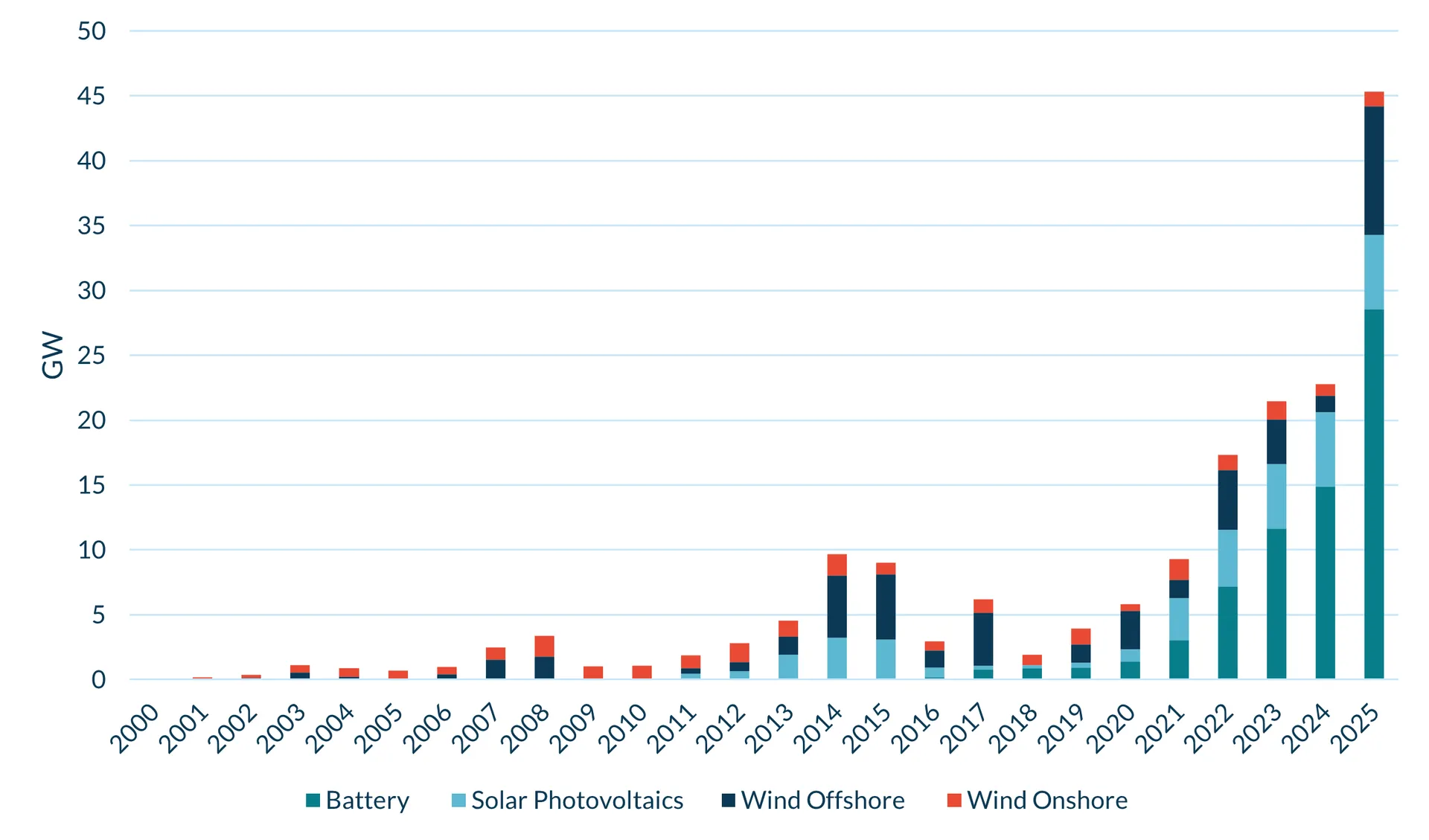
Selected renewables technology capacity by year in which planning permission was granted (Source: Cornwall Insight)

Planning approvals have accelerated significantly. Around 30GWh of BESS capacity was consented in 2025, almost double the 2024 level, the highest annual total to date, with larger projects with longer duration becoming the norm, numerous single site schemes now exceed 1GWh. Cumulatively, approved projects now exceed 160GWh, while around 22GWh is under construction and over 13GWh is operational. Strong demand remains for well developed ‘Ready to Build’ BESS projects and Elgar Middleton is in contact with over 100 interested and willing buyers for the right project.

Grid Reform

The UK is undergoing the most significant reform of its electricity grid framework in decades, driven by the urgent need to connect low carbon generation, storage, and demand more quickly, while supporting the Government’s Clean Power by 2030 target. The centrepiece of reform is a wholesale overhaul of the grid connections process, led by the National Energy System Operator (NESO). Historically, grid access operated on a “first come, first served” basis, resulting in a severely congested queue of more than 700GW of generation and storage projects, many of which were speculative or inactive. Under the new “first ready, first connected” regime, projects must demonstrate planning progress, land rights, and strategic alignment with national energy needs to retain or secure a connection offer.

As of late January, NESO announced the 2026/27 transmission projects will not receive their offers by the end of January putting increased pressure on 2026/27 connection dates for both transmission and distribution projects. Many projects are in a state of limbo with neither equity investors nor debt providers willing to commit capital until the actual connection time and cost are confirmed for 2026/27 projects. With long lead times of 12-15 months for such item as switchgear and transformers, from order to installation timeframes means 2026 is near impossible for pre-construction projects and 2027 is becoming increasingly challenging. This could result in a depleted pipeline of constructed projects in 2026/27 putting even more pressure on the 2028 to 2030 rollout.

Revenue Stack Fundamentals

UK BESS revenues are typically derived from a diversified “revenue stack” rather than a single contracted offtake. The core components include:

    • Wholesale Market (WM), capturing intraday and day-ahead price spreads;
    • Balancing Mechanism (BM) participation, responding to system imbalances;
    • Ancillary services, such as Dynamic Containment, Dynamic Regulation and Dynamic Moderation whereby assets are available to maintain grid stability and which are procured close to real time; and
    • Capacity Market (CM) contracts, rewarding assets’ contribution to security of supply and which are often secured well in advance of construction.

The composition of the revenue stack is fluid. The suite of ancillary services has changed over time, and the current products historically offered attractive margins, particularly during early market phases when competition was limited. However, these revenues have shown rapid price erosion as new capacity enters the market and markets saturated. In contrast, WM and BM revenues are deeper and structurally more durable, but all trading revenues are inherently volatile and exposed to macro drivers such as gas prices, interconnector availability, and weather.

For debt providers, the critical question is not whether any particular revenue stream(s) can form a business case for a storage asset but whether a combination of these can be underwritten with sufficient confidence over the debt tenor. Fully merchant revenue stacks may be acceptable for equity investors seeking upside, but they pose challenges for lenders required to size debt against downside scenarios. As a result, bankability is increasingly linked to revenue stabilisation mechanisms; however, where lenders have a high degree of confidence in and understanding of the revenue forecasts, material levels of non-recourse debt can be supported by merchant cashflows for appropriately structured projects.

Revenue Volatility, Forecasting and Duration

Market forecasting lies at the heart of BESS financing and is often the most heavily scrutinised element of lender due diligence. Unlike contracted renewables, BESS revenues cannot be extrapolated from a fixed tariff or a single price curve. Instead, they require sophisticated modelling of, dispatch optimisation based on the appropriate level of foresight available to traders at the time. The modelling is more challenging still in less developed storage markets in which rules for market participants are still evolving. Most financings rely on independent market consultants to develop merchant revenue forecasts. These forecasts typically combine historical price data, forward market curves, and fundamental modelling of supply, demand, and capacity additions. Importantly, they also attempt to capture the impact of increasing BESS penetration on future profit pools, such as in ancillary services where saturation can (and did) occur quickly.

Sensitivity analysis is also critical. Lenders will test downside scenarios including reduced price volatility, faster than expected battery build out, and increased competition from flexible gas or new interconnectors. Unlike in the financing of renewable generators, lenders also need to consider the performance of the asset optimisers; this is typically covered both by sensitivity analysis but also by ensuring debt and equity providers are able to incentivise optimiser performance appropriately.

A further challenge for forecasters is that there is no such thing as a generic asset. Location (which informs the ability to capture outsize revenues in the BM) and technical parameters (including round-trip efficiency, degradation, and duration) are important inputs into the dispatch modelling. There is often an iterative process required to determine the best site configuration taking into account site-specific constraints (available land, planning permission, any grid limitations) and the economics of longer / shorter durations, higher / lower cycling, etc.

As a consequence of reduced cells prices and increased cell density the UK market can now support up to 4 hour duration as a realistic base case system, but analysis of market forecasters curves and cell prices has demonstrated this may not necessarily be optimal and a one size fits all is not the way forward. Elgar Middleton is working closely with a number of equity investors and debt providers to find an optimal solution for each client, taking into consideration round-trip efficiency, degradation, and durations ranging between two and four hours.

A further dimension is operational strategy: aggressive cycling to maximise short term revenue may reduce long term asset value through accelerated degradation. Elgar Middleton has structured loan agreements with a number of debt providers to offer equity investors maximum flexibility to cycle an asset aggressively when the market dictates it makes sense, while aligning short term dispatch strategies with warranty constraints, lifecycle optimisation and senior debt tenor by using structured upside and downside cash sweep structures.

Revenue Structures

The UK market has rapidly evolved with many optimisers now active in the market with a range of products. While the market is predominantly dominated by the big utility companies, other optimisers include dedicated boutiques with bespoke trading algorithms, energy trading desks of investment banks, equipment manufacturers and in-house specialists using their platform to manage their own assets. Leaderboards of all publicly traded markets rank the various optimisers performance, although the producers of those benchmarks would be the first to acknowledge their limitations – not least that they will not capture all revenue sources of the various optimisers.

Several contractual structures are now common:

    • Fully merchant optimisation, where a specialist provider operates the asset in return for a performance‑linked fee.
    • Tolling arrangements (physical or virtual), under which a counterparty pays a fixed or semi‑fixed fee for control of dispatch.
    • Revenue guarantees or minimum revenue floors, providing partial revenue protection in exchange for more limited upside.

From a lender’s perspective, the value of these contracts lies not just in reducing volatility, but in reallocating risk to parties better able to manage it. Counterparty credit quality, contractual tenor, benchmarking and termination rights are all debated at great length with lenders in order to find a bankable solution.

In the current market, the majority of clients of Elgar Middleton wish to maximise gearing in order to optimise equity IRR – and given the significant divergence between the cost of capital of equity and debt; structured debt significantly improves equity returns. As more assets reach operation and performance data accumulates, both optimisers and capital providers are converging on structures that balance risk sharing with economic efficiency, thereby improving overall bankability. Two years ago, floors were all the rage while tolls offered little value to equity investors given the relative pricing of floors vs tolls. Fast forward to today and the floor market is now thin while there is healthy competition between physical and virtual tolls and as duration increases, there is more flexibility to hedge only a portion of the total MWh to find an optimal mix of hedge vs merchant component in order to structure a highly geared project with equity upside.

Elgar Middleton undertakes this analysis using a bespoke financial model for each client as there are some subtle differences between each route to obtaining a level of contracted revenue capable of supporting high levels of debt.

Outlook for UK BESS Financing

The outlook for UK BESS financing is positive, but increasingly nuanced. Demand for grid scale storage is structurally supported by the UK’s decarbonisation trajectory, electrification of heat and transport, and continued renewable build out. As a result, BESS is likely to remain a core component of the UK power system for decades.

Not all BESS projects will be treated equally. Elgar Middleton can attest from the sale of our clients’ RtB projects that those that combine strong grid locations, strong phase 2 grid offers, low or no curtailment, longer duration and limited planning conditions will always attract strong interest.

Equity investors are rightly focussed on grid reform at the moment and concerned about the timing of (1) grid offers and (2) actual connection dates which has proved critical to some given the challenges of actually building out the upgraded grid network up and down the country.

Lenders are mostly concerned with revenue structures, cycling strategies and counterparty risk especially given the multitude of varying solutions available from the market but as more structured products become available debt tenor and levels of gearing are both increasing.

Elgar Middleton has closed almost 2GWh of BESS, both RtB sales and numerous debt transaction using fully merchant, floors and tolls and understands the unique idiosyncrasies of each. Ultimately, successful financing of UK BESS projects will depend on a clear understanding of where risk truly sits and structuring projects accordingly.

The unsung hero of project finance

Project management sits at the heart of every successful financing. At Elgar Middleton, it is a core capability that sets us apart and drives smoother processes and better outcomes for our clients

In the project finance industry, headlines typically focus on who provided the debt, the structure of the deal, or the scale of the assets involved. What often goes unnoticed, however, is the orchestration that sits behind every successful close.

Complex financings require the input of multiple advisors – legal, technical, insurance, tax, and market consultants – each with their own specialist language, priorities, and deliverables. Without strong project management, these parallel workstreams risk misalignment, delays, or even jeopardising bankability.

At EM, we believe project management is not a side task – it is a core capability. It is one of the ways we distinguish ourselves as a financial advisor, ensuring that complex transactions run smoothly, efficiently, and with fewer surprises.

Our approach brings structure and momentum to every financing process, giving clients confidence that all moving parts are being managed in a coordinated and proactive way.

Turning Complexity into Coordination

EM typically runs the Request For Proposal (RFP) processes for all key advisors on a debt raise, supporting the client in selecting them; as we know the expected scope of lenders will expect we can streamline the due diligence and also ensure there is no overlap between advisors – the most material of which is any duplication of work between the borrower’s lawyers and the lenders’ lawyers – which can result in a substantial cost saving in addition to efficiency. EM also manages the entire execution process through to financial close; this means coordinating weekly calls across all stakeholders, ensuring high quality deliverables are produced on time, and bridging the inevitable gaps between disciplines. EM often kick-start workstreams long before a borrower or its other advisors would necessarily commence them, (for instance direct agreements or title searches) which otherwise can be left to the last minute.

We actively engage with each workstream, and our team is fluent in the language of each discipline. This “translation” role is often the difference between issues being resolved in real time or becoming bottlenecks late in the process.

For example, when the lender’s legal advisor requires confirmation on battery warranties, we ensure the lender’s technical advisor provides clear, bankable input. If market consultants update their revenue forecasts, we work with the technical advisor to confirm that assumptions are accurately reflected in the technical model. And when insurance advisors flag gaps in cover, we make sure these are addressed in the contract suite before they create a financing risk.

Tangible Benefits for Clients

For our clients, this hands-on project management translates directly into better outcomes. By identifying and resolving issues early, we reduce execution risk and prevent costly surprises. With all workstreams aligned and momentum maintained, transactions move more quickly to close, saving valuable time and management focus. At the same time, cohesive and comprehensive deliverables give lenders greater confidence.

In short, EM allows sponsors to concentrate on growing their business and developing projects, while we drive the financing to completion.

Most financial advisors provide good NPV analysis of the term sheets submitted as part of a financing process but EM goes much further. EM has a bespoke term sheet for each renewables sub-sector and these are well understood by all active lenders in the UK market. Detailed term sheet negotiations not only make commercial sense but increase efficiency; this approach gives us existing precedents with most competitive UK lenders and therefore fast tracks the facility agreement negotiations – again, saving time and fees.

A Unique Approach in the UK Market

This level of embedded project management requires not only transaction expertise, but also a deep technical understanding and a willingness to take ownership of the detail. For EM, it is part of our DNA.

We see our role not just as financial advisors, but as the glue that binds every workstream together – giving sponsors and lenders the confidence that their transaction is being advanced on all fronts.

If you are planning a financing or considering a sale in the renewables sector and want an advisor who will not only secure capital but also manage the complexity of the process, we would be delighted to speak with you.

EM closes up to €150m in mezz financing to accelerate BESS rollout in Germany

Elgar Middleton is please to have advised Terra One on the cross-border mezzanine financing to support the build-out of their German battery storage portfolio.

Elgar Middleton is pleased to announce its role as exclusive financial advisor to Terra One on securing up to €150 million in mezzanine financing from Aviva Investors, supporting the build-out of a pipeline of battery energy storage system (BESS) assets across Germany.

The investment will be used to fund asset level equity contributions toward the construction and operation of a large portfolio of grid-scale battery projects, representing a critical step in advancing Europe’s energy transition. The facility structure allows for drawdowns against a broad pool of eligible projects and includes an accordion feature to support future growth.

Importantly, it enables Terra One to build out and wholly own its BESS portfolio without dilution, while retaining full flexibility to maximise trading revenues through the use of its proprietary optimisation software and in-house trading team.

The transaction forms part of a wider capitalisation strategy, enabling Terra One to invest up to €750 million into its BESS platform – with a target of deploying approximately 3 GWh of storage capacity across the continent.


SAE closes the financing of a 120MW/240MWh BESS asset

Elgar Middleton is pleased to have advised SAE on the financing of the 120MW Afon Wysg BESS asset.

Elgar Middleton is pleased to announce its role as exclusive financial advisor to SAE Renewables (“SAE”) on the financial close of the 120MW / 240MWh AW1 battery energy storage system (BESS) project, located in Uskmouth, South Wales.

The financing structure combined multiple capital sources across several layers of the capital stack. SAE’s equity contribution was underpinned by a combination of internal funding, a £8.5m corporate-level loan from Cardiff Capital Region (CCR), £9 million of proceeds from the sale of project land to Electric Land, which it subsequently leased back, and a contribution from a global renewable energy group as minority investor. Senior debt of £45.3 million was provided by Norddeutsche Landesbank (Nord/LB).

The AW1 project has a contracted grid connection date of October 2026 that will allow for project commissioning, and an anticipated full commercial operations start date during Q1 2027. It is SAE’s flagship project within its pipeline at the Uskmouth Sustainable Energy Park, which has the potential to be one of the largest battery storage sites in the UK. The successful financing establishes SAE’s continued commitment to renewing the Uskmouth site and surrounding area.

This transaction highlights Elgar Middleton’s proven track record in delivering complex, multi-party financings for cutting-edge energy infrastructure. Our team worked closely with SAE and all counterparties to design and execute a tailored capital structure that met the project’s unique commercial and strategic objectives.

For more information about our work in the energy transition and battery storage sectors, please contact the Elgar Middleton team

Cambridge Power closes the sale of a co-located UK solar/BESS asset

Elgar Middleton is pleased to have advised Cambridge Power on the sale of their co-located BESS/solar asset.

Elgar Middleton is pleased to announce its role as exclusive financial advisor to Cambridge Power on the successful sale of a co-located 49.9MW / 100MWh battery energy storage system (BESS) and 70MWp solar PV project to AGR Renewables .

The ready-to-build project, located in Yorkshire, represents a significant contribution to the UK’s growing pipeline of co-located renewable energy assets and highlights the continued investor appetite for high-quality development sites within the solar and storage sectors.

AGR Renewables will take the project forward through construction and into operation, continuing its investment in flexible, renewable infrastructure across the UK.

This transaction adds to Elgar Middleton’s extensive track record in the UK battery storage sector, where the firm has advised on a wide range of M&A and project financing mandates across both standalone and co-located BESS projects.

Field closes the financing of a 125MW / 250MWh portfolio of UK BESS assets

Elgar Middleton is pleased to have advised Field on the financing of their latest portfolio of assets.

Elgar Middleton managed the financing from lender selection through to financial close. Rabobank and ING provided £42m of debt comprising a term loan, DSRF and VAT facility.

The term loan is to be used to fund the construction and operation of 3x 2-hr BESS assets. Field’s in-house trading platform Gaia will be utilised for asset optimisation once the assets reach operations. The transaction included a number of structural protections for the lenders for a range of different scenarios to enable them to offer higher gearing than would otherwise have been available and to offer Field maximum operational flexibility.

This is the second financing on which Elgar Middleton has advised the Field team and we remain committed to assisting Field in their efforts to grow their UK and European portfolios.

Marx was right (about financial modelling)

Without wishing to bring politics into it, one may wonder whether endorsing Karl Marx might be somewhat career-limiting for a representative of a firm whose raison d’être is to facilitate the efficient allocation of capital. But in one respect, at least, he had a point. One of his many disputes with classical economists concerned division of labour: whilst Adam Smith, famously, saw this as a foundation for economic progress, Marx saw it as a way to achieve bad results (albeit he may have accepted that it would achieve those bad results pretty quickly and effectively). Where we as a firm are out-and-out Marxists is that we do not believe that division of labour leads to good financial models or good financial advice.

First, a bit of context. In the world of energy transition assets or businesses, financial models fall broadly into three categories: appraisal, transaction, or operational. Appraisal models are used to assess investment opportunities and need to be flexible to easily evaluate different financing or revenue structures; transaction models are used to support specific investments and need to be a precise reflection of the underlying asset or business; and operational models are used as a monitoring or reporting tool that need to accommodate actual data (some of which may not have been envisaged in earlier model iterations). These types of models have different and often competing priorities – but the approach to model building and maintenance often fails to reflect this.

A caricature of your average financial modeller in energy and infrastructure teams – whether advisor or principal side – is the (or, possibly, one of the) junior team members who, after a year or two, will graduate from the modelling team and join the ranks of their esteemed colleagues who might occasionally be permitted to talk to a human being that works at a separate organisation. This is equally applicable irrespective of the type of model being developed. This sort of division of labour means that there is correspondingly a split between the individuals who build and operate the model, and those who interpret the results and best understand the broader context.

One can understand the appeal of such a team structure and why it is as common as it is. It might be appropriate for appraisal modelling (where ‘close enough’ may be good enough, and where everyone is working at risk) or for operational modelling (where asset management teams need ‘pure’ modelling support to integrate a new front end to the model which better reflects reality). It is also quite profitable as it involves delegating work that can be done fairly well to cheaper people. However when it comes to transaction modelling, ‘fairly well’ or ‘close enough’ often won’t cut it.

Risks

The big risks associated with the division of labour come from a model giving the wrong answers without anyone being any the wiser. It isn’t hard to see how this might come about: say, a new set of model inputs arrives and there’s a cost missing; or a revenue projection arrives and there is an embedded implicit assumption around asset availability that is inappropriate for your site – but there isn’t the knowledge or experience base to query these inputs. As a result, you end up a few £m out on capex or you overstate your revenues by a few %.

Whilst modelling oversights are best avoided at any stage, there is a greater chance of minimising the impact in appraisal models; significant contingencies are frequently included to manage the unknown risks, and errors may only lead to an opportunity cost based on a misevaluation. But as part of a transaction these mistakes can be fatal: you end up basing an investment decision on a flawed model. Routine due diligence checks don’t always pick up these points; for example, a model audit will check that the model inputs align with documentation, but they won’t tell you if there’s something missing from or inappropriate about said inputs.

Another risk is highlighted by comparing two approaches: do you model the negotiations, or do you negotiate using the model? Division of labour between negotiator and modeller nudges you towards the former, but the latter is clearly preferable – you don’t want to agree principles that when quantified turn out to be unworkable or suboptimal. However, if it is to be delivered then it is necessary for the negotiating team to have a deep understanding of both the model and the market.

An added bonus of negotiating from the model is that principles that are slightly ambiguous can often be firmed up in a manner suiting both borrowers and lenders. Such opportunities are liable to be missed if the person staring at the spreadsheet has only a limited awareness of the broader deal context. We’ve seen this on a few occasions on recent UK BESS deals where we have found ways to meet certain covenants imposed by lenders without making overly large concessions; the alternatives were often high cost (to equity) and low benefit (to everyone).

Value

As well as reducing downside, minimising friction between the deal team and the modelling team (ideally by making them one and the same) has clear ‘base case’ benefits.

We typically find that there is a time saving to be had because modelling can be better integrated into the deal as a whole and it avoids too much back-and-forth between those doing the work and those checking the work. An experienced and informed modeller will have (or will more rapidly develop) a good sense of what analysis is necessary or helpful, thereby improving the quality of output. Instead, a modeller who is divorced from the broader transaction often ends up running scenario after scenario without any great appreciation for the end goal. This is supposed to get to the same point eventually, and perhaps it will – but at best it will take longer.

There is also an opportunity for extracting the most from every pocket of value when modelling can be done by those who know how to get the best out of the model. To give an example of this kind of financial engineering: a typical approach to debt sizing around multiple constraints is to assess the debt (profile and amount) in a lender base case, to assess the debt (profile and amount) in a downside case, and to take the lower of the two. This guarantees meeting one of your two constraints, but tends to leave projects both undergeared and at risk in certain periods (i.e. lower return, higher risk). Instead this should be approached period-by-period, which effectively requires the running of multiple cases concurrently. In order to achieve this, some (but not an enormous amount of) technical modelling skill is required. However, if you are asking the modeller the questions “does this work for lenders?” and “is this fully optimised?”, it will take more than just that modelling skill to give you confidence in their answers – it takes some transaction knowledge and transaction experience.

Conclusion

Financial modelling in support of transactions should not be treated as a standalone workstream. At least one of the individuals responsible for knowing pretty much everything about the broader deal should also know pretty much everything about the model: where the inputs come from, how robust they are, how they are treated in calculations, and where the resulting pinch points may be.

This is (and has always been) our preferred approach at Elgar Middleton where transaction experience and expertise is fully integrated with the financial modelling. Delivery of a transaction is not the same as the sum of the parts – too much division of labour and you will end up with a worse, riskier, deal. Financial modelling is not the only component that is extracted from the broader transaction work, but it is often the most tempting; it is a temptation that should be resisted.

Trends in AD project financing

AD projects in the UK are leveraging innovative revenue streams such as gas-to-grid integration, RTFCs, and CO₂ recovery to enhance financial viability. These trends present an attractive proposition for lenders

Financing anaerobic digestion (“AD”) projects has historically been a challenge due to significant capital expenditure, high running costs, volatile revenues and other perceived risks around the actual process.

However, until around a decade ago, projects could rely on FITs and ROCs to support electricity generated from CHP units and RHI payments to support gas injected into the grid. Raising debt finance for an operational asset with these support payments and documented operational history was therefore possible as this mitigated a number of the risks.

Most AD plants in operation today benefit from one of these subsidy payments. As these are no longer available for new developments the financial landscape of AD projects has evolved, primarily driven by innovative revenue models that go beyond just electricity generation and RHI payments.

Revenue streams from additional gas-to-grid integration with the Green Gas Support Scheme, associated subsidies like Renewable Transport Fuel Certificates (RTFCs) and carbon dioxide recovery are gaining traction, making AD projects more attractive again to debt providers.

The approximate income from some of these revenue streams is shown below.

Gas-to-Grid Integration

Biomethane, produced by upgrading biogas, is a renewable and sustainable alternative to natural gas. Under the previous subsidy regimes, a number of AD plants were built with gas-to-grid connections; however, many of these projects involved contractual arrangements with Air Liquide rather than direct management of the equipment and sale of the gas through a Biogas Purchase Agreement (BPA).

A key trend recently is to install new gas-to-grid connections to inject biomethane into the national gas grids and to manage the sales of the gas through a BPA. This gives the projects access to current high gas prices and also allows for price fixing which provides a stable revenue which is very attractive to lenders. Furthermore, where projects already have a CHP unit in place, it allows the sponsor to optimise returns by choosing whether to run the CHP or to inject gas into the grid.

Unusually, this is also an area that benefits from a new subsidy – the Green Gas Support Scheme. Under this scheme generators are able to apply for a 15 year support payment which is linked to CPI. This is a very attractive revenue stream when looking for debt finance.

Renewable Transport Fuel Certificates (RTFCs)

RTFCs have also emerged as a potential revenue driver for AD projects, particularly those that supply biomethane.

RTFCs are awarded to producers of renewable fuels that are used for transport. Crucially, the generator is still eligible for the certificates through a sleeving arrangement. Therefore existing gas-to-grid plants that are not eligible for the Green Gas Support Scheme are able to sell their gas to transport companies that take their supplies from the grid.

The pricing of the subsidy is more volatile than the Green Gas Support Scheme, so this option is probably a second choice for new generators; however, governments are mandating increased use of renewable fuels in transport which has resulted in increased demand for RTFCs.

RTFCs are also tradable, allowing producers to optimise their value based on market conditions.

We think that this stream of revenues would certainly be useful for sponsors, but would need to be part of a larger mix to attract debt finance.

CO₂ Recovery

The capture and commercialisation of CO₂ from biogas upgrading is an emerging trend that also enhances AD assets’ economics.

The process involves separating carbon dioxide during the biomethane upgrading process and selling it to industries such as food and beverage, agriculture, or even for carbon sequestration purposes.

With increasing focus on carbon-neutral solutions, demand for sustainable CO₂ sources is rising.

Many AD projects are now integrating CO₂ capture technologies, supported by government grants or incentives for carbon capture and utilization (CCU) initiatives.

Again, this is very much a nice to have revenue stream and would need to be part of wider revenue mix to attract debt finance.

Waste management and gate fees

The investor case for many of the existing AD plants relied on gate fees for processing food waste. Unlike other sectors, such as biomass, AD plants were being paid to receive feedstock. Unfortunately, some of these fees have not been as high as expected, and in some cases, AD plants have had to pay for the waste.

The tightening of environmental regulations, including landfill bans and the future organic waste separation mandates should increase demand for sustainable waste treatment solutions like AD. Many in the sector are confident that gate fees will rebound to investor expectations from a number of years ago. Location of competitors and proximity to food waste will remain a key driver to the pricing.

For project sponsors, securing long-term contracts for waste supply with steady gate fee revenues enhances the financial stability and bankability of AD plants.

Revenue stacking

Many of these revenues can be claimed at the same time as shown in the graphs below.

Agriculture

At EM our focus has been on AD plants based on food waste, but there are many agricultural AD plants which use the same technology to process slurry and energy crops such as maize. These fell out of favour as whilst the processing of slurry is indisputably good for the environment, the increasing reliance on energy crops such as maize was not considered to be as helpful.

Traditionally, they have been much harder to debt finance as lenders do not like the exposure to individual farmers who provide the crops and are largely not creditworthy. The perceived risk is that the AD plant may need to source its crops from an external market at a prohibitive cost when delivery is factored in.

That said, for many investors, agricultural AD has been one of their best and most reliable performers.

All the comments above about new revenue streams should apply to this sector as well.

Key considerations

While new revenue streams significantly enhance the bankability of AD projects, they come with challenges.

Gas-to-grid infrastructure and CO₂ recovery systems require substantial capital investment and advanced technology. They need to be designed correctly and installed by reliable bankable counterparties. Lenders may also need time to become comfortable with the new revenue streams.

Furthermore, subsidies such as RTFCs and support schemes for biomethane are subject to political shifts, posing risks to long-term revenues. The value of RTFCs and CO₂ themselves fluctuate based on supply-demand imbalances and policy changes.

Conclusion

The AD sector is rapidly evolving, with new revenue opportunities reshaping its financial landscape. These trends not only improve the financial viability of AD projects but also align them with global decarbonisation goals. For project developers and investors, understanding and leveraging these revenue streams is critical to unlocking the full potential of AD projects in the renewable energy transition.

Update on the UK renewables debt market

Elgar Middleton continues to support our clients raising debt finance at project and portfolio level within the UK market. This article highlights our current view of the lending market.

Generally, the UK renewables lending market appears to be in good state – all core technologies are being greeted with appropriate funding solutions and lenders’ commitments to the wider sector continues to show growing robustness.

Lender types & domiciles

The UK renewables market continues to not only attract the interest of banks offering project finance debt but also the interest of institutional investors. Elgar Middleton has seen an increase in interest from institutional investors able to offer debt solutions to UK situated projects/ portfolios although it is important to note that institutional investors have not yet proven to be as competitive on pricing when compared to banks.

Lenders to the UK renewables market come from all over the world. Elgar Middleton is seeing attractive terms from lenders based in North America, Asia and Australia as well as continued support from familiar lenders in the UK and Europe. This is consistent with the view that the UK remains a leading country with regards to net zero energy production and retains an attractive lending environment.

Elgar Middleton will always look at the lenders’ experience in the UK market during a funding competition as this can offer insights into the long-term relationship between the sponsor and lenders.

Debt products available

Lenders continue to offer a wide array of debt solutions to the UK renewables market with the vast majority able to offer project finance debt accompanied by a VAT facility and derivatives such as interest rate and inflation swaps. Furthermore, most lenders are now comfortable with a debt service reserve facility as opposed to an account.

HoldCo financing options such as acquisition finance and revolving credit facilities are still attractive to some lenders, but they are typically preferred by lenders who are not able to compete in the long term asset level project finance market. Furthermore, it is mostly banks rather than institutional lenders who are capable of offering these facilities.

Preferred ticket size

The minimum ticket size for some lenders is now around £25-30m although this can depend on the asset class – the more risky sectors with higher margins can still be profitable with smaller tickets. The sweet spot for many lenders is around £75m on a take and hold basis. Whilst a number of lenders would finance transactions with loans in excess of £100m, they would typically look to sell down some after financial close. This can then lead to discussions around the level of support the sponsors should provide the lenders to help with syndication.

Most financings which require more than £100m of debt will use club deals of at least two lenders. This helps to avoid any discussions, and cost, around underwriting, but it can make it more time consuming to agree terms. This is an area where a well-developed term sheet really helps.

Preferred maturity

It remains the case that shorter term financing is cheaper and easier for lenders to offer than longer term financing. It therefore has the widest range of interested lenders and is the most competitive option; however, typically when a sponsor factors in the refinancing risk and cost, the long term financing option offers better value for money.

There are now a significant number of lenders who can finance a period of construction plus a 15 year CFD. To be competitive, lenders are required to go beyond the CFD period in the form of a merchant tail. The market has not converged on a standard approach, not helped as always by volatile power curves, but we do think that the market now requires some form of merchant tail, typically at least 3 years. We regularly analyse multiple different permutations available to establish what offers our clients the best option.

Whilst subsidy free wind and solar transactions have declined due to the availability of CFDs, if 10-year bankable corporate PPAs returned to the market, we would expect lenders to finance a merchant tail of at least 5 years. As with the CFD financings, there is not a standard approach and the high breakeven power prices since the energy crisis can be hard for some lenders to accept.

We continue to see enthusiasm for merchant-only battery debt financings. This market is being helped by the competitive nature of the optimiser market where floor prices are offering lenders some fixed revenue protections. We continue to see a requirement for a tail between the debt maturity and the warranty expiry and, as a result, notional loan tenors are now around 10-13 years post COD with a legal tenor of around 5-7 years. In comparison to the wind and solar market, the BESS market continues to evolve at a rapid pace. A key part of what we do at Elgar Middleton is to help with this evolution to ensure the sponsors obtain the very best terms.

Elgar Middleton’s role in debt financing

Elgar Middleton has extensive experience in arranging debt finance for solar, wind and BESS projects having closed 45 debt transactions totalling almost £6bn. In addition to comprehensive knowledge of structuring bankable offtake arrangements and financial modelling to optimise a sponsor’s gearing and equity IRR. This experience assists our clients not only in designing their sites optimally from the outset, but also to achieve the lowest cost of capital from the debt markets, thereby maximising their investment returns.

Boralex closes its first project financing in the UK – Limekiln Wind Farm

Elgar Middleton is pleased to have advised Boralex Inc. (“Boralex”) (TSX: BLX) on the long-term financing of its largest project in Europe, the 106MW Limekiln Wind Farm.

Elgar Middleton managed the financing process from lender selection through to financial close.

The lenders to the transaction are National Westminster Bank PLC (NatWest) and Export Development Canada (EDC), for an aggregate amount of up to £130M. NatWest will also act as facility agent, security agent, hedge counterparty and account bank.

Limekiln Wind Farm is located near Thurso in Caithness, Scotland and will consist of 24 Vestas V136-4.5MW wind turbines, measuring 150m to the tip of the blade. In the 2023 AR5, the project secured a 15-year Contract for Difference. The project is expected to be commissioned by the end of 2024.

In addition to the zero-carbon electricity, Limekiln will also deliver a full package of social, economic and environmental benefits, including biodiversity enhancements such as a native species planting scheme and a peat restoration programme, as well as a Community Benefit Fund of over £500,000 per annum for the life of the project. In addition, the project offers local employment opportunities: the site’s construction phase could directly support more than 100 jobs, and its operation, more than 90. Lastly, the wind farm will provide sufficient electricity to meet the needs of around 100,000 British homes based on the average generation mix of UK power sources.

Elgar Middleton originally advised Boralex on its acquisition of  Infinergy, the owner of Limekiln and a number of other sites under development in Scotland.  Elgar Middleton looks forward to continuing to advise Boralex as it develops this pipeline of assets.